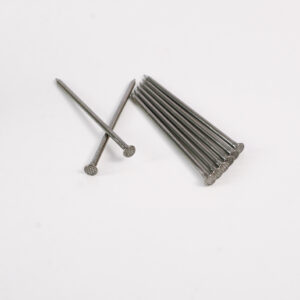
Common wire nails 2.5 inch are a practical size for buyers sourcing nails for timber work, wooden packaging, general construction, and hardware distribution. The length is 2-1/2 inches, or 63.5 mm. However, length alone is not enough for an accurate quotation: buyers should also confirm wire gauge, shank diameter, finish, head style, point, packing, and order quantity.
This guide explains the reference specification, approximate pieces per kilogram, common applications, and the details importers and distributors should include in an RFQ.
Common Wire Nails 2.5 Inch: Reference Specification
A commonly requested combination for this length is 2-1/2 × 11 BWG. The following figures are useful for preliminary purchasing and shipping calculations.
| Item | Reference value |
|---|---|
| Nominal length | 2.5 inches / 63.5 mm |
| Reference wire gauge | 11 BWG |
| Reference shank diameter | 3.05 mm |
| Approximate weight per 1,000 pieces | 3.58 kg |
| Approximate pieces per kilogram | 279 pieces |
Important: these are reference figures for the stated size combination, not a universal value for every 2.5-inch nail. Actual piece count can vary with shank diameter, head dimensions, point geometry, material density, and production tolerance. Confirm the approved sample or final specification before using the figure for packing, costing, or project calculations.
How Many 2.5-Inch Common Nails Are in One Kilogram?
For the 2-1/2 × 11 BWG reference specification above, one kilogram contains approximately 279 nails. Buyers can use the following formulas for an initial estimate:
- Estimated pieces = net nail weight in kg × 279
- Estimated net weight in kg = required pieces ÷ 279
For example, a 25 kg carton would contain about 6,975 pieces, while 1,000 kg would contain about 279,000 pieces. These calculations are for planning only. The final commercial quantity should follow the agreed net weight, piece-count tolerance, and packing method.
Typical Uses of 2.5-Inch Common Wire Nails
This size is commonly considered for general fastening jobs where a medium-length smooth-shank nail is suitable. Typical purchasing applications may include:
- wooden crates and export packaging;
- pallet and timber component assembly;
- general carpentry and workshop use;
- temporary timber work and non-specialized construction fixing;
- hardware-store and building-material distribution.
The correct nail for a specific joint depends on timber type, required withdrawal resistance, corrosion exposure, local building requirements, and the project design. For structural or regulated work, the project specification should determine the required nail dimensions and performance.
What Buyers Should Confirm Before Ordering
Two suppliers can both quote “common wire nails 2.5 inch” while offering different diameters, finishes, and package weights. A clear RFQ reduces price confusion and helps the supplier prepare a comparable offer.
1. Length and diameter
State both the nominal length and the required shank diameter or wire gauge. For example: 2-1/2 inch × 11 BWG, approximately 63.5 × 3.05 mm. If your market uses a different diameter for the same length, send the millimeter measurement rather than relying on the product name alone.
2. Surface finish
Specify whether you need a bright/polished finish or a galvanized finish. The suitable option depends on storage conditions, transport, corrosion exposure, and the end-use environment. Ask the supplier to identify the proposed finish clearly in the quotation and sample approval.
3. Head, shank, and point
Confirm the head style and diameter, smooth-shank requirement, point shape, and any market-specific appearance requirements. These details affect driving behavior, holding performance, weight, and the number of nails per kilogram.
4. Packing and labeling
Common wholesale formats may include small boxes, inner boxes in master cartons, or bulk cartons. Your RFQ should state net weight per package, gross-weight limits, label language, barcode requirements, carton marks, pallet preference, and any distributor branding.
5. Inspection method
Before shipment, agree on how length, diameter, straightness, head condition, finish, package net weight, and quantity tolerance will be checked. A retained approved sample or signed specification sheet gives both parties a clearer reference.
A Practical RFQ Example
Common wire nails, 2-1/2 inch × 11 BWG (63.5 × 3.05 mm), smooth shank, bright finish, [required net weight] per carton, [required quantity], private label required, destination port: [port and country]. Please confirm production tolerance, packing details, lead time, and sample availability.
If the diameter, finish, or packing is still undecided, describe the application and destination market. An experienced supplier can then recommend practical options for comparison without assuming an unsuitable specification.
Why the Exact Specification Matters in Bulk Purchasing
For importers and distributors, a small difference in shank diameter changes the weight per thousand pieces and therefore affects the approximate piece count in each carton. It can also affect material consumption, quotation comparison, and customer expectations. A purchase order that includes only “2.5-inch nails” leaves too much room for interpretation.
The safest approach is to approve a complete specification covering dimensions, finish, packaging, labeling, tolerances, and inspection. Buyers can review KIN METAL’s common nails product page for available supply options or use the contact page to send a detailed inquiry.
Frequently Asked Questions
Is 2.5 inches exactly 63.5 mm?
Yes. The mathematical conversion is 2.5 × 25.4 = 63.5 mm. Actual manufactured length should still be assessed according to the agreed tolerance.
Are all 2.5-inch common wire nails 11 BWG?
No. The length and wire diameter are separate purchasing parameters. The 11 BWG / 3.05 mm combination in this guide is a reference specification. Buyers should confirm the diameter required in their market.
How many 2.5-inch common nails are in 1 kg?
For the reference 2-1/2 × 11 BWG specification, the estimated count is about 279 pieces per kilogram. The actual count varies with the finished nail dimensions and production tolerance.
What information is needed for a wholesale quotation?
Provide length, shank diameter or BWG, finish, head and point requirements, packing, total quantity, label requirements, and destination port. Photos, an existing sample, or a specification sheet can make the quotation more accurate.
Request a Common Nails Quotation
KIN METAL supplies nails and fastening solutions for importers, wholesalers, hardware distributors, construction suppliers, and project buyers. Send your required size, finish, packing, quantity, and destination through our request-a-quote page. We will review the specification before preparing an offer.