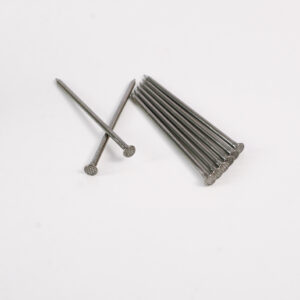
For a roofing-material distributor, buying aluminum nails is a specification decision, not just a price comparison. The nail must suit the roof covering, supporting deck, exposure conditions and installation instructions. This guide explains how to prepare an aluminum roofing nails wholesale inquiry so that quotations from different suppliers can be compared on the same basis.
Aluminum nails are non-ferrous fasteners used in selected roofing and exterior applications. Some asphalt-shingle installation instructions permit them; solid aluminum clout nails are also sold for slate fixing. That does not mean one aluminum nail works for every roof. Always follow the covering manufacturer’s current instructions, project drawings and local code.
Where Are Aluminum Nails Used?
Asphalt shingles where the system allows them
For example, Owens Corning’s Duration Series installation instructions list aluminum alongside galvanized steel and stainless steel for that particular shingle system, while also setting minimum fastener dimensions and deck-penetration requirements. This is a product-specific example, not a universal rule for all shingles. Confirm the exact shingle model and installation document before ordering.
Slate roofing and clout-nail applications
Wide-head aluminum clout nails can be specified for slate in some markets. Olympic Fixings, for instance, identifies its solid-aluminum plain-shank clout nails as slate nails. For wholesale procurement, confirm the slate system’s required nail material, head, shank, diameter and length rather than substituting a visually similar roofing nail.
Compatible metal or fiberglass roofing details
Aluminum roofing nails are also offered for selected aluminum and fiberglass roofing materials; Clendenin Brothers’ aluminum roofing range illustrates smooth and ring-barb shanks and optional sealing washers. Whether a nail is suitable for a particular panel, substrate or exposed fixing point depends on that system’s fastening schedule. A washer, where specified, must be matched to the roof assembly rather than added as a generic upgrade.
What Should a Distributor Specify?
A complete request for quotation should identify the finished fastener, not merely say “aluminum nail.” The following checklist helps prevent mismatched samples and prices.
| RFQ field | What to confirm | Why it matters |
|---|---|---|
| Application | Shingle, slate, metal panel or other approved system; deck material | Determines the required geometry and installation rules |
| Material | Solid aluminum or a different construction; alloy/temper if the specification requires it | “Aluminum cap” on a steel nail is not a solid aluminum nail |
| Dimensions | Length, shank diameter or gauge, head diameter and tolerances | Controls fit, hold-down and required penetration |
| Shank and point | Smooth, ringed or another approved profile; point style | Affects installation and withdrawal resistance |
| Sealing detail | Washer material, size and assembly, if required | Must match the roof manufacturer’s fixing detail |
| Packing | Pieces or weight per inner box, carton weight, pallet, labels and barcode | Determines landed cost and distributor-ready presentation |
| Commercial terms | Order quantity, destination port, target delivery date and inspection needs | Makes the quotation usable for an import decision |
Aluminum vs. Galvanized Steel or Stainless Steel
Aluminum does not form red iron rust, which can be useful where staining and material compatibility matter. However, material choice should never be based on that property alone. Aluminum, galvanized steel and stainless steel differ in mechanical behavior, corrosion performance in specific environments, cost and compatibility with adjacent materials. Moisture, salt exposure and dissimilar-metal contact may affect the design. Ask the roof-system manufacturer or project engineer to approve the fastener material for the actual assembly.
The same caution applies to substitution: a distributor should not replace a specified steel or stainless fastener with aluminum simply because the length and head diameter appear equal. A sample and written approval are especially important for unusual substrates, high-wind details or coastal projects.
How to Compare Wholesale Quotations
- Use one drawing or reference sample. Include a dimensioned sketch when head profile, shank pattern or washer assembly is critical.
- Compare identical specifications. Check whether each quote covers solid aluminum, the same dimensions, the same packing quantity and the same inspection criteria.
- Request a pre-production sample when needed. Measure length, diameter, head and shank; check driving and fit against the intended substrate.
- Check landed cost. Compare price basis, carton count, palletization and destination—not unit price alone.
- Confirm documentation. Agree on any material declaration, dimensional report, packing list or destination-market paperwork before purchase.
Request an Aluminum Nails Quotation from KIN METAL
KIN METAL lists Aluminum Nails in its product range. To check current availability and obtain a comparable B2B quotation, send us your application, nail drawing or photo, material requirement, length, shank and head dimensions, quantity, packaging preference and destination port. We will confirm which specifications can be supplied before you commit to an order. You can contact KIN METAL here.
Frequently Asked Questions
Are aluminum roofing nails suitable for every asphalt shingle?
No. Some manufacturers allow aluminum nails for specific shingle systems, but others may require different materials or dimensions. Check the current instructions for the exact product and local code before placing a wholesale order.
Are aluminum clout nails the same as steel nails with aluminum caps?
No. A solid aluminum clout nail is made from aluminum through its head and shank. A steel nail with an aluminum cap has a different construction. Specify which product you need in the RFQ.
What information is essential for a bulk quote?
At minimum, provide the application, material, length, shank diameter, head diameter, shank type, quantity, packaging and destination. A photo, drawing or sample helps confirm any non-standard detail.