If you sell nails to UK or Irish buyers, one of the most common sourcing mistakes is sending a quotation written in American terminology. A UK importer does not search for “common nails” or “finish nails” the same way a US contractor does. They search for bright nails, galvanised nails, clout nails and masonry nails – often with the British spelling that Google UK expects.
This guide maps British and American nail terminology side by side, explains what each term actually means, and shows exporters how to write product titles and category pages that rank for UK and Irish buyers.
Why British Terminology Matters for SEO and Sales
Google serves different results to UK, Irish and US searchers, and it matches the spelling and phrasing used in each market. When a UK buyer types “galvanised nails” (with an “s”), a product page titled “galvanized nails” (with a “z”) is much less likely to rank. The same applies to category names: UK builders merchants such as Screwfix and Toolstation organise their fastener sections with categories called Bright Nails, Galvanised Nails, Masonry Nails and Collated Nails.
For a Chinese nail exporter, the practical consequence is simple: if you want UK and Irish wholesale or importer traffic, your catalogue, category pages and articles need a UK-English version in addition to the US-English version.
British vs American Nail Terms: The Master Table
| British / UK term | American / US term | What it means |
|---|---|---|
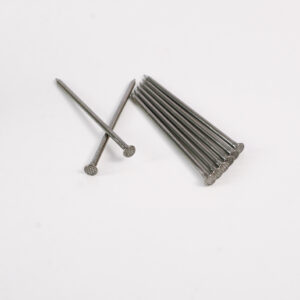
| Bright nails | Common nails / bright common nails | Uncoated, polished steel wire nails – the everyday general-purpose nail |
| Galvanised nails | Galvanized nails | Zinc-coated nails for exterior and treated-timber use; UK spelling keeps the “s” |
| Clout nails | Roofing nails (clout head) | Short nails with a wide flat head for roofing felt, fencing and battens |
| Masonry nails | Concrete nails / masonry nails | Hardened steel nails for fixing into brick, block and concrete |
| Lost head nails | Finish nails / brads | Nails with a small head that is punched below the surface, for joinery and trim |
| Oval wire nails | Finish nails (oval) | Oval-section nails that resist splitting in hardwood trim |
| Wire nails | Common wire nails | The generic term for standard round wire nails |
| Panel pins | Brads | Very thin small-head nails for light woodwork and mouldings |
| Roofing felt nails | Cap nails / felt nails | Nails with a large washer cap used with roofing felt and membranes |
| Collated nails | Collated nails | Nails joined in strips or coils for nail guns – same term, but UK buyers specify coil/strip format differently |
The Terms UK and Irish Buyers Actually Search For
Google Trends data for the UK and Ireland confirms which terms carry real search demand:
- Common nails – still searched in the UK (relative score 35) and Ireland (29), so keep “common nails” as a secondary keyword.
- Finish nails – UK (30) and Ireland (35), the most searched nail type in Ireland.
- Clout nails – UK (7) and Ireland (4); a small but highly commercial niche with very little supplier content.
- Framing nails – UK (20) and Ireland (24), used mainly by builders and timber-frame contractors.
- Coil nails – almost zero in the UK and Ireland (1); US-style coil nail terms are not the way to reach European buyers.
The pattern is clear: British English, application-led terms, and UK-specific product categories outperform American tool-spec terminology in the UK and Irish market.
How to Write Product Titles for UK and Irish Buyers
Follow the category naming used by UK builders merchants, then add the specification detail that importers need:
- Category page: “Galvanised Nails – Hot Dip and Electro Galvanised | UK Export Sizes”
- Product title: “3.35mm Galvanised Clout Nails – 25mm Roofing Felt Nails, Carton 25kg”
- Product title: “Bright Wire Nails – 50mm x 2.65mm, Loose or Boxed, Container Export”
- Product title: “Masonry Nails – Hardened Steel, 30mm x 3.35mm, UK Retail Pack”
Notice the format: British spelling first, then the specification (shank diameter x length), then the packing unit. This matches how UK wholesalers search and how Screwfix and Toolstation structure their own ranges.
Standards UK and Irish Importers Expect
US buyers quote ASTM F1667 and penny sizes; UK and Irish buyers think in millimetres and European standards:
- EN 14592 – the European standard for nails used in timber structures.
- CE marking and, since Brexit, UKCA marking for construction products placed on the UK market.
- BS 5534 – the British standard for slating and tiling, which specifies minimum 3.35mm shank clout nails for roof battens.
- Millimetre sizing – e.g. 50mm x 2.65mm, not “10d”.
An exporter that can quote millimetre sizes, EN/UKCA compliance and BS 5534 references in one document has a clear advantage over competitors who only quote US standards. For timber fasteners, European buyers also recognise EN 14592; quoting it alongside millimetre sizes signals the factory can ship to EU documentation.
Action Plan for Exporters
- Create a UK-English version of your nail catalogue with British spellings (galvanised, lost head, panel pins).
- Build category pages using UK merchants’ language: Bright Nails, Galvanised Nails, Masonry Nails, Collated Nails, Clout Nails.
- Add standards pages covering EN 14592, UKCA and BS 5534 so UK importers find you during compliance research.
- Quote millimetre sizes and carton weights in kilograms, and offer UK retail pack sizes alongside export cartons.
England, Scotland and Ireland: Regional Calling Conventions
British terminology is not perfectly uniform. A merchant in Glasgow and a builder in Cork may use different everyday words for the same fastener:
- Panel pins are the UK standard term for small brads used in joinery; Irish catalogues also list panel pins, while American catalogues call them brads or finish nails.
- Oval wire nails are common across England and Wales; Irish merchants more often say oval nails and list them alongside lost head nails.
- Clout nails are understood across the UK and Ireland, but sizes are quoted in millimetres, whereas a US buyer expects penny sizes (3d, 4d, 6d).
- Roofing felt in the UK corresponds to felt paper or underlayment in the US, and the fasteners used for each are described completely differently.
The practical rule: write for the buyer’s local catalogue, not for the factory. If you export to both markets, run separate UK and US product listings with local spelling, local sizes and local standards.
Example Product Titles That Work in the UK
These title formats follow how UK merchants actually describe nails in their own catalogues:
- “Galvanised Clout Nails 3.35mm x 25mm – Roofing Felt & Batten Fixings (1kg Pack)”
- “Lost Head Nails 50mm x 2.65mm – Satin Chrome Finish, for Architraves & Skirting”
- “Bright Panel Pins 25mm – Pack of 1000, for Joinery & Furniture”
- “Hot-Dip Galvanised Wire Nails 75mm x 3.75mm – Fence & Framing (EN 10244-2)”
- “Masonry Nails 40mm – Case-Hardened, for Concrete & Brick (25kg Export Carton)”
Each title contains the UK search term, the millimetre size, the application and the pack format. That is the same structure UK merchants use when they reorder, so it is also the structure your product titles should follow.
Building a UK-English Category Structure
The fastest way to win UK clicks is to mirror how UK merchants organise their websites. A UK-focused catalogue should group products under headings such as:
- Bright Nails
- Galvanised Nails
- Lost Head Nails
- Panel Pins
- Clout Nails
- Masonry Nails
- Collated Nails
Each category page should carry the UK spelling, millimetre sizing, a UK pack option and a standards note. This structure matches the way UK buyers search, and it makes internal linking between product and guide pages natural.
How to Write Meta Titles and Descriptions for the UK
Localisation is not only about the product page body. Search snippets decide whether a UK importer clicks your listing:
- Lead with the UK term, not the US term: “lost head nails” not “finish nails”.
- Include the millimetre size and the application in the title.
- Use British spellings in the description: galvanised, metre, programme.
- Mention UK-specific references – BS 5534, EN 14592, UKCA – where relevant.
- Add a UK pack size (1kg, 5kg, 25kg) so the snippet matches local buying habits.
A page optimised for “lost head nails 50mm” will outperform the same page written for “finish nails 2 inch” in every UK and Irish search.
Common Listing and Translation Mistakes
- Using “finish nails” instead of “lost head nails” – UK buyers search the latter.
- Quoting penny sizes (8d, 10d) without millimetre equivalents.
- Writing “galvanized” with a z – British spelling is “galvanised”.
- Translating “clout nail” as “roofing nail” – they are different products in the UK.
- Missing British pack conventions: 1kg, 5kg and 25kg boxes instead of US count-based packs.
Quick Glossary for Export Sales Teams
| UK / Irish term | US term | What it is |
|---|---|---|
| Lost head nail | Finish nail | Small head sunk flush, for joinery |
| Oval wire nail | Oval brad / oval nail | Oval shank for skirting and architraves |
| Panel pin | Brad | Very small pin for trim and furniture |
| Clout nail | Roofing nail (approx.) | Wide flat head for felt and boards |
| Wire nail | Common nail | Standard round-shank nail |
| Masonry nail | Concrete nail | Hardened nail for block and brick |
| Galvanised | Galvanized | Zinc-coated |
Nail Terminology FAQs
What do UK buyers call finish nails? Lost head nails, and for smaller sizes, panel pins.
Is a clout nail the same as a roofing nail? In the UK, clout nails are the felt and batten fastener; US roofing nails are longer and ring-shanked. Quote the UK term to the UK market.
Should I use “galvanised” or “galvanized” on my UK site? Use “galvanised” for the UK and Ireland and “galvanized” for the US. Match the local spelling of the market you serve.
Do I need separate UK and US product pages? Yes. Separate pages with local titles, sizes and standards rank better in both markets than one generic page.
UK Spelling Quick Rules for Product Copy
British spelling is one of the cheapest localisation wins in export e-commerce. Four rules cover most nail catalogue copy: use “galvanised” not “galvanized”, “metre” not “meter” (except measuring instruments), “programme” for a plan but “program” for software, and “colour” not “color”. Spellings affect search results too – a UK importer typing “galvanised nails” will not click a page written entirely with American spellings. Run every UK product page through a British-English check before publishing, including meta titles, descriptions and alt text, because every one of those fields is searchable.
Nail Terminology FAQs: More Answers
Should I translate sizes to millimetres for UK buyers? Yes. Quote 50mm x 2.65mm instead of 2″ x 11 gauge; UK merchants think in millimetres and kilogram pack weights.
Is “wire nails” a UK term? Yes – “wire nails” is standard across the UK and Ireland for round-shank nails, while US catalogues more often say “common nails”.
How Kinmetal Can Support UK and Irish Importers
Kinmetal manufactures bright nails, galvanised nails, clout nails, masonry nails and collated nails in both US and UK specification formats, with full COA and test documentation. We quote millimetre sizes, export cartons and retail packs, and we can supply EN 14592 / UKCA-compliant documentation for qualifying orders. Browse our nail range or send your UK-market RFQ for a same-week quotation.
Next step: if you are sourcing for the UK market, also read our guide to clout nails for roofing felt and battens and our UKCA vs CE marking checklist for importers.