Clout nails are the quiet workhorse of British roofing and fencing. A clout nail is a short nail with a wide, flat head designed to hold roofing felt, battens, fence boards and felt-backed tile underlay without tearing through. In the UK and Ireland they are specified every day by roofers, fencers and builders merchants – yet very few suppliers publish a proper specification guide, which makes this one of the clearest content gaps in the nail export market.
This guide covers clout nail sizes, the 3.35mm shank rule in BS 5534, material and coating options, and exactly what UK and Irish importers need on a quotation.
What Is a Clout Nail?
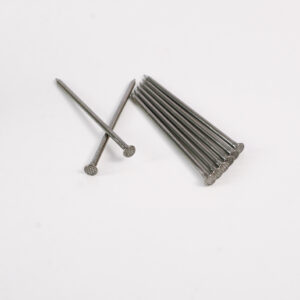
A clout nail (sometimes written “clout nail” or “clout-head nail”) is defined by its head: a broad, flat head that spreads the clamping load over a wide area. This head shape stops the nail pulling through soft materials such as roofing felt, EPDM, battens and fence laths. Clout nails are usually short – typically 20mm to 40mm – and are driven by hand, which is why they are also called “hand drive clout nails” in collated form.
They should not be confused with roofing nails used for asphalt shingles in North America. UK clout nails are specified for felt and battens, and the UK market sizes them in millimetres, not penny sizes.
Clout Nail Sizes UK Buyers Specify
| Length | Typical shank | Common use |
|---|---|---|
| 20mm | 2.65mm – 3.35mm | Felt to timber, light fence laths, greenhouse felt |
| 25mm | 2.65mm – 3.35mm | Standard roofing felt fixing, fence boards, batten fixing |
| 30mm | 3.00mm – 3.35mm | Battens and felt, heavier fence work |
| 40mm | 3.35mm | Roof battens to rafters where required, fencing rails |
| 50mm | 3.35mm+ | Heavy fencing and timber-to-timber fixing |
For roofing work, the critical specification is the 3.35mm minimum shank required by BS 5534 for fixing roof battens. If a quotation shows a thinner shank, the roofer cannot use it for batten fixing, and the sale is lost. Exporters should also know BS 1202, the classic British nail specification still referenced in UK merchant catalogues.
BS 5534 and the 3.35mm Rule
BS 5534, the British standard for slating and tiling, is the document UK roofing contractors work to. Its key requirement for nails: roof battens must be fixed with nails of at least 3.35mm shank diameter, and the nail must penetrate the rafter or truss by a minimum of 15mm (some batten specifications require more). The Roof Tile Association (RTA) publishes the same guidance in its batten fixing advice.
For exporters this means:
- Quote batten nails as “3.35mm x 40mm” or “3.35mm x 50mm” so compliance is obvious.
- Provide the penetration calculation (batten thickness + 15mm into the rafter) in your technical data.
- Offer stainless steel clout nails for coastal areas and for green oak where corrosion is a concern.
Material and Coating Options
- Bright clout nails – cheap, indoor and dry uses such as felt to sheds and internal fence work.
- Electro-galvanised clout nails – light corrosion protection, good for general fencing and outbuildings.
- Hot-dip galvanised clout nails – the standard for exterior roofing felt and battens; thicker zinc coating per BS EN ISO 1461 requirements.
- Stainless steel clout nails – A2 (304) or A4 (316) for coastal, marine and treated-timber applications.
UK importers will ask “galvanised” by default. Do not assume electro-galvanised is enough: for roofing felt and battens, hot-dip galvanised is the safer default to quote.
Collated Clout Nails
Roofers fixing large felt and batten areas increasingly use collated clout nails in nail guns. These come in:
- Strip collated clout nails – paper tape or plastic strip, for strip nailers.
- Coil clout nails – wire-welded coils for coil nailers.
If you supply collated clout nails to the UK, always confirm the collation angle (typically 15° or 21°) and head type (full round head versus clipped head) against the roofer’s tool, and state the coil diameter and count on the carton.
Packing and Quotation Checklist for UK Importers
- Millimetre sizes, not penny sizes: “3.35mm x 40mm galvanised clout nails”.
- BS 5534 / EN 14592 reference for batten nails.
- Hot-dip galvanised or stainless option for exterior use.
- Carton weight in kilograms, nails per carton, and retail pack option (e.g. 1kg, 5kg).
- COA and mill test certificate for container orders.
Clout Nail vs Slate Nail vs Roofing Nail
UK buyers often use “clout nail” loosely, but the fastener family contains three distinct products. Selling the right one the first time avoids a returned container:
| Fastener | Typical head | Main use | Typical length |
|---|---|---|---|
| Clout nail | Wide, flat, round | Roofing felt, battens, fence boards | 20-50mm |
| Slate nail | Large flat head, often copper or aluminium | Fixing slates and tiles | 25-40mm |
| Roofing nail (US style) | Large cap or ring-shank head | Shingles and underlayment | 25-75mm |
Clout nails are the correct choice for felt and soft board; slate nails have a broader, thinner head for brittle materials; US roofing nails are longer and often ring-shanked for shingle work. Quotations should name the product explicitly in UK terms so the buyer never has to guess.
Head Diameter and Shank Length by Application
Head diameter matters as much as length. A head that is too small pulls through the felt; an oversized head is hard to drive flush. UK specifiers typically look for a head around 8-10mm on a 3.35mm shank clout nail.
- Roofing felt (3.35mm x 19-25mm): the standard felt and batten fixing size; the 3.35mm shank references BS 5534 batten fixing guidance.
- Battens (3.35mm x 30-40mm): a longer shank for driving through battens into rafters or trusses.
- Fence boards (3.75mm x 40-50mm): a heavier shank and larger head for weatherboarding and fence panels.
- Felt underlay and sarking (3.35mm x 25mm): one of the most common retail pack sizes in UK builders’ merchants.
Hot-Dip vs Electro Galvanised: Which to Choose for the UK
Coating choice decides how long the nail survives in a damp, coastal or industrial roof environment:
- Electro-galvanised (EG): bright, smooth finish at low cost, suited to indoor and dry applications. Not recommended for exposed roofing felt in wet climates.
- Hot-dip galvanised (HDG): a thicker zinc layer with a dull grey finish and a much longer outdoor service life. The standard choice for roofing felt and battens where condensation or coastal air is present.
- Stainless steel: for marine, chemically treated timber and premium projects. It costs more but eliminates rust staining on white felt, rendered walls and light-coloured fascias.
UK importers should ask for the coating standard (EN 10244-2 for zinc coatings) and a minimum coating weight in grams per square metre, not just “galvanised”.
Why 3.35mm Became the UK Standard Shank
The 3.35mm shank is not an accident. It matches the common batten gauge used across the UK roofing trade and balances holding power against wood splitting. A thinner shank holds felt less securely and can pull through in wind uplift; a thicker shank risks splitting the batten during installation. The 3.35mm size – combined with the compatible collation for coil nailers – is the specification that UK merchants, roofers and importers quote by default. When a buyer writes “3.35mm clout nails”, they expect a 3.35mm shank, not a 3.35mm head diameter. This one detail causes more specification errors than any other, so write the shank diameter explicitly on every quotation and carton label.
Packing Sizes UK Merchants Actually Stock
Retail demand in the UK is pack-driven. Merchants reorder the pack sizes their customers recognise:
- 1kg retail boxes of 3.35mm x 25mm galvanised clout nails – the fastest-moving line.
- 5kg boxes for builders and roofers on medium jobs.
- 25kg export cartons or 20kg loose cartons for trade counters and national distributors.
- Collated coils (typically 120-300 nails per coil) for roofing crews with coil nailers.
If a quotation offers only “boxes of nails”, ask the importer which pack format their market expects. The same nail sold in the wrong pack will not move off the shelf.
Writing Clout Nail Quotes the UK Way
UK buyers recognise these line descriptions instantly:
- “Hot-dip galvanised clout nails, 3.35mm x 25mm, 1kg retail box”
- “Bright clout nails, 3.75mm x 40mm, 25kg export carton”
- “Stainless steel clout nails (A2), 3.35mm x 30mm, 5kg box”
Put the shank diameter first, then length, then finish, then pack. That order matches the way UK merchants search and reorder, and it leaves no room for interpretation.
Storing and Handling Clout Nails in Merchants’ Stock
Roofing fasteners can spend months on merchants’ shelves before use. Simple handling rules protect the coating and the merchant’s margin:
- Keep cartons dry; zinc coatings last longest in low-humidity storage.
- Avoid mixing electro and hot-dip stock in the same box – a rust complaint usually traces to mixed finishes.
- Rotate stock by date code and label the coating type on the retail pack.
- For coil or collated clout nails, store flat so the collation strip does not deform.
Clout Nail FAQs
What size clout nails for roofing felt? For felt on timber battens, 3.35mm x 19-25mm is the standard; for felt on sarking boards, 3.35mm x 25mm is common.
Are clout nails the same as roofing nails? No. Clout nails have a wide flat head and short shank for felt and boards; roofing nails are longer and often ring-shanked for shingles.
What does BS 5534 say about clout nails? BS 5534, the UK code of practice for slating and tiling, references batten fixing; the 3.35mm shank clout nail is widely used for felt and batten work.
Do clout nails come in collated strips? Yes – coil clout nails (15°-16°) are used with coil nailers on larger roofing jobs.
Should I use hot-dip or stainless clout nails by the coast? For coastal exposure, hot-dip galvanised is the minimum; stainless steel (A2/A4) is recommended within a few hundred metres of the sea.
What Roofers Check on the Carton
Experienced roofers verify three things before opening a new box of clout nails. They check the shank diameter against the specification, confirm the coating type by colour and finish, and look for the size in millimetres rather than a trade name. A carton labelled only “clout nails 25mm” with no shank size or coating information is a warning sign. Suppliers who print the full specification – shank diameter, length, finish, standard and pack weight – on every label make the roofer’s check fast and reduce returns at the merchant counter.
Clout Nail FAQs: More Answers
What is the head size on a standard clout nail? For a 3.35mm shank clout nail, the head is typically 8-10mm in diameter, wide enough to hold felt without tearing but small enough to drive flush.
Can clout nails be used for fence boards? Yes – a 3.75mm x 40-50mm galvanised clout nail with a large head works well for weatherboarding and fence panels, though ring-shank alternatives hold better in soft timber.
Where to Source Clout Nails in Export Quantities
Kinmetal manufactures bright, electro-galvanised, hot-dip galvanised and stainless steel clout nails from 20mm to 50mm, including 3.35mm shank sizes compliant with BS 5534 batten fixing guidance. We quote in millimetre sizes, provide full COA documentation, and can supply retail packs or export cartons. See our roofing and clout nail range or request a UK-market quotation.
Next step: for roofers and importers, pair this guide with our British vs American nail terminology guide and our UKCA vs CE marking checklist so your UK catalogue is fully compliant and searchable.