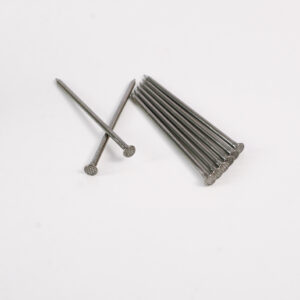
Galvanized clout nails 2.8x32mm are short, wide-head fasteners used where a standard nail head may pull through a thin or relatively soft material. The size describes a shank diameter of 2.8 mm and a length of 32 mm. Their broad, flat head spreads pressure over a larger area, while the galvanized surface helps protect the steel from corrosion.
This specification is commonly considered for roofing felt, selected sheet materials, boards, cladding components and general timber work. However, the correct nail is determined by more than length and diameter. Buyers also need to confirm the head dimensions, shank style, steel grade, galvanizing method, packaging and intended exposure before placing a bulk order.
This guide explains what importers, distributors and construction-material buyers should check when sourcing 2.8 x 32 mm clout nails. For a broader size comparison, read our roofing felt nails and clout nails buying guide.
What Does 2.8x32mm Mean?
The two measurements describe the main nail dimensions:
- 2.8 mm: nominal shank diameter
- 32 mm: nominal nail length, normally measured from below the head to the point
These dimensions alone do not provide a complete purchasing specification. Two products described as clout nails 2.8x32mm may still differ in head diameter, head thickness, point shape, shank finish, zinc coating and package weight. For repeat orders, these additional details should be recorded in the purchase specification and checked against an approved sample.
| Item | Typical order description |
|---|---|
| Product | Clout nails |
| Nominal size | 2.8 mm x 32 mm |
| Material | Carbon steel or as agreed |
| Head | Wide, flat head |
| Shank | Smooth unless otherwise specified |
| Superficie | Electro-galvanized or hot-dip galvanized, as agreed |
| Point | Diamond point or approved reference |
| Embalaje | Small retail packs or bulk export packing |
The table is an RFQ starting point, not a substitute for a drawing, reference sample or project requirement.
Why Do Clout Nails Have a Wide Flat Head?
The wide head is the feature that separates a clout nail from many general-purpose nails. It increases the bearing area on the fixed material and helps reduce pull-through. This makes the design useful when fastening felt, thin sheet products and selected boards to timber.
The head does not automatically make the nail suitable for structural connections. Standard clout nails should not replace approved connector nails, screws or other engineered fasteners in joist hangers, load-bearing brackets or safety-critical assemblies. For such work, follow the project engineer's specification and the applicable local requirements.
Applications of Clout Nails 2.8x32mm
The suitability of a 32 mm clout nail depends on the fixed material, the timber substrate, the required penetration and the installation environment. Common applications may include:
Roofing felt and membrane-related work
The broad head can help hold roofing felt or similar sheet material without concentrating pressure in a small area. Installers should follow the membrane manufacturer's instructions for fastener material, spacing and overlap. In highly exposed conditions, a more corrosion-resistant fastener or a different fixing system may be required.
Boards and selected interior materials
Clout nails may be used for certain boards, panelling and other non-structural fixing work. The nail length must provide sufficient penetration into the supporting timber without damaging concealed services or the finished surface.
Thin sheet or cladding components fixed to timber
For compatible systems, the flat head helps resist pull-through when a thin component is fixed to timber framing. The buyer must confirm that the selected coating and nail material are compatible with the sheet or cladding system. Some manufacturers specify hot-dip galvanized or stainless-steel fasteners for particular exposure zones.
General construction and timber work
The 2.8 x 32 mm size can also be used in suitable light-duty, non-structural jobs. It should not be described as a universal roofing nail: substrate density, material thickness, edge distance, moisture exposure and required holding performance all affect the final choice.
Choosing the Galvanized Finish
For a closer coating comparison, see our electro-galvanized vs hot-dip galvanized clout nails guide.
“Galvanized clout nails” is not a complete coating specification. Buyers should state whether they require electro-galvanizing, hot-dip galvanizing or another agreed finish.
Electro-galvanized clout nails
Electro-galvanizing normally produces a smoother, more uniform appearance and is often considered for relatively mild exposure. It should not be assumed to provide the same protection as a specified hot-dip galvanized coating.
Hot-dip galvanized clout nails
Hot-dip galvanizing is generally selected when stronger corrosion protection is required for outdoor or damp service. The surface is usually rougher than an electro-galvanized finish, and coating requirements should be agreed before production.
Stainless-steel alternatives
Coastal, chemically aggressive or otherwise severe environments may require stainless-steel fasteners. Material compatibility also matters: an unsuitable fastener can contribute to corrosion or staining in the surrounding component. The project specification should take priority over a general product recommendation.
When requesting a quotation, do not rely only on terms such as “galvanized” or “rustproof.” State the required coating process, applicable standard if any, and service environment. If a numeric coating requirement is necessary, include it in the purchase specification and inspection plan.
How to Check Whether 32mm Is the Correct Length
The selected nail must pass through the fixed material and achieve adequate penetration into the timber substrate. A 32 mm length may be suitable for some thin materials, but the visible material thickness is only one part of the calculation.
Before ordering, confirm:
- The thickness and compressibility of the material being fixed.
- The type and density of the supporting timber.
- The minimum penetration required by the system supplier or project specification.
- Whether a membrane, batten, cavity or multiple material layers are involved.
- The required fastener spacing and exposure conditions.
If the application is uncertain, send the supplier a drawing, installation photo or material sample rather than choosing the nail by name alone.
Packaging Options for Wholesale Orders
Retail markets often use small packs such as 500 g, 1 kg or 5 kg. Importers and distributors may also require larger cartons or bulk-packed nails. Available formats depend on the supplier and production arrangement.
A complete packaging instruction can include:
- Net weight per inner box or bag
- Number of inner packs per export carton
- Carton gross weight and dimensions
- Plain, branded or private-label packaging
- Barcode and label content
- Pallet requirements
- Moisture protection for sea transport
- Country-of-origin and importer information
Package weight should be included in pre-shipment inspection. For weight-packed nails, the number of pieces per pack can vary because of normal dimensional and manufacturing tolerances. If the buyer sells by piece count, the counting method and tolerance must be agreed separately.
Quality Checks for Bulk Clout Nails 2.8x32mm
For a repeatable supply program, inspect both the nails and the packaging. A practical checklist includes:
- Nail length and shank diameter
- Head diameter, shape and thickness
- Shank straightness
- Point formation and sharpness
- Surface condition and visible coating consistency
- Bent nails, damaged heads and excessive burrs
- Net package weight
- Label, barcode and carton-mark accuracy
- Carton strength and pallet condition
Visual inspection alone cannot confirm coating mass, material grade or mechanical performance. When these properties are important, define the test method, sampling plan and acceptance criteria in the purchase order before production.
Information to Include in Your RFQ
An RFQ that says only “clout nails 2.8x32mm” will usually lead to additional questions and may produce quotations that are difficult to compare. For a more accurate offer, provide:
- Product: clout nails
- Size: 2.8 mm x 32 mm
- Head diameter or approved sample
- Material requirement
- Shank type
- Galvanizing method and coating requirement
- Intended application and exposure environment
- Packing format and private-label requirements
- Order quantity
- Required documents or inspection conditions
- Destination port and requested trade term
Clear specifications reduce quotation revisions and help the supplier evaluate tooling, coating, packing and shipment requirements correctly.
Source Galvanized Clout Nails from KIN METAL
KIN METAL supplies nails and fastening products for importers, hardware distributors and construction-material buyers. Standard and customized dimensions, finishes and export packaging can be discussed according to the target market and order requirements.
For a quotation for galvanized clout nails 2.8x32mm, send us your required galvanizing method, head dimensions, packing, quantity and destination port through our contact and quotation page. If you are matching an existing market product, include a photo, drawing, label or reference sample so the specification can be reviewed before production.
Frequently Asked Questions
What are clout nails 2.8x32mm used for?
They are commonly considered for roofing felt, selected boards, thin sheet or cladding components fixed to timber, and other light-duty construction applications. Suitability depends on the substrate, material thickness, penetration and project requirements.
Are 2.8x32mm clout nails suitable for outdoor use?
They can be supplied with a galvanized finish for improved corrosion protection, but “galvanized” covers different processes and protection levels. The coating should be selected for the actual exposure. Severe or coastal environments may require a specified hot-dip coating or stainless steel.
Are clout nails structural fasteners?
Standard clout nails are generally treated as non-structural fasteners. Do not use them in engineered connections unless the project specification and relevant approvals explicitly permit it.
What is the difference between a clout nail and a common nail?
A clout nail has a wider, flatter head designed to spread pressure and reduce pull-through in thin or softer materials. A common nail normally has a smaller head and is used for general timber fastening.
Can clout nails be supplied in custom packaging?
Depending on order quantity and production arrangements, suppliers may offer small packs, bulk cartons, private-label boxes, barcodes and customized shipping marks. Confirm every packaging detail in the RFQ.
What should I send to receive an accurate quotation?
Send the size, head dimensions, material, shank, galvanizing requirement, packing, quantity, destination port and any applicable inspection or documentation requirements. A reference sample or drawing is helpful for exact matching.