Ring Shank vs Smooth Shank Nails: Pull-Out Resistance and When to Use Each
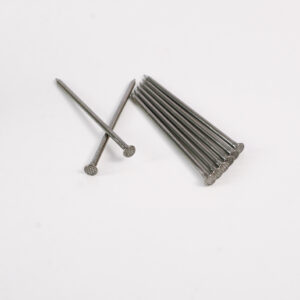
Two nails with the same length and gauge can perform very differently in the same piece of wood. The difference is the shank. A smooth shank nail relies on friction, while a ring shank nail bites into the wood fibres with a series of annular rings – and that mechanical bite can roughly double the withdrawal (pull-out) resistance.
For pallet makers, subfloor installers, roofers, furniture factories and anyone buying nails in volume, choosing ring vs smooth shank is a real cost and performance decision. This guide explains how the two compare, when the extra holding power is worth the price, and exactly what to specify in your order.
If you are still deciding between fastener families, our roofing nail selection guide covers coatings and sizes, and this article focuses on the shank geometry itself.
How Ring Shank Nails Work
Ring shank nails have annular rings pressed or rolled into the shank during manufacturing. Once driven, wood fibres lock into those rings and create a mechanical grip that resists the nail pulling back out. The effect is strongest in softwoods and in applications subject to vibration, uplift or seasonal moisture movement.
Smooth shank nails have no rings and depend only on friction between the steel and the wood. They drive faster, use less force and cost less, but their withdrawal resistance is significantly lower – and it drops further as the wood dries, shrinks and loses its grip on the smooth surface.
There is a third option worth knowing about: screw shank (spiral) nails, which have a twisted thread instead of rings. They combine the driving behaviour of a nail with a screw-like bite, and are covered in detail in our screw nail guide. Ring shank is usually preferred when maximum lateral and withdrawal strength in pallets and framing is required.
Pull-Out Resistance: What the Numbers Say
Withdrawal resistance depends on many variables – wood species, moisture content, penetration depth, gauge and coating – so treat every number as a guideline. The commonly cited range for ring shank nails is roughly 1.5 to 2 times the withdrawal resistance of an equivalent smooth shank nail, and some published fastener tests show even higher ratios in dry softwood. Pull-out testing in the industry is benchmarked against ASTM F1667 (driven fasteners) and EN 14592 (timber dowel-type fasteners), so citing a standard makes comparisons between suppliers meaningful.
| Factor | Smooth Shank | Ring Shank |
|---|---|---|
| Withdrawal resistance | Baseline | Roughly 1.5-2x (typical range) |
| Holding in dry, shrinking wood | Weakens over time | Holds better |
| Behaviour under vibration / uplift | Works loose sooner | Resists loosening |
| Ease of driving | Easier, faster | More force required |
| Removal / rework | Easy to pull | Hard to remove cleanly |
| Cost per 1000 | Lower | Higher |
Because the grip is mechanical rather than frictional, ring shank nails also perform better in engineered wood products such as OSB, plywood and LVL, where smooth shank nails can slip along the glue lines under load.
When to Use Ring Shank Nails
- Pallets and crates: vibration during transport is exactly what pulls smooth shank nails loose. Most high-capacity pallet plants specify ring shank or screw shank for deck-to-stringer joints.
- Subfloor and decking: ring shank nails are the standard fix for squeaky floors because they keep panels tight to the joists as the wood moves.
- Roofing in high-wind zones: uplift resistance is a code concern; ring shank roofing nails provide extra security against wind suction.
- Treated and engineered lumber: where wood movement is greater, the mechanical grip pays off over the life of the structure.
- Plywood formwork and shuttering: vibrating concrete tries to lift the panel; ring shank nails hold the form together.
When Smooth Shank Is Enough
Use smooth shank nails for interior trim, light framing, crating where disassembly is expected, and any application where the fastener will be pulled out later. Smooth shank is also the economical choice when holding power is not the failure risk – for example, nailing through thin materials where the head and the thickness of the material do the work.
For distributors, the practical rule is simple: keep smooth shank as the value line for general carpentry and packaging, and stock ring shank where your customers mention pallets, subfloors, uplift or vibration. A two-line inventory covers most demand without over-stocking.
Galvanized Ring Shank Nails: Coating Matters Too
Ring shank nails are available in bright, galvanized (electro or hot-dip), and stainless finishes. The coating protects the steel, not the grip, but the two work together:
- Bright ring shank: lowest cost, indoor pallets, crates, furniture and dry framing.
- Electro-galvanized ring shank: light corrosion protection for interior and semi-exposed work at a small premium.
- Hot-dip galvanized (HDG) ring shank: thick zinc coating for exterior roofing, fencing, coastal and high-moisture applications.
- Stainless ring shank: for marine and chemically aggressive environments where any rust is unacceptable.
When ordering, remember that “galvanized ring shank nails” is not a complete specification – your supplier needs the coating type, coating weight, length, gauge and application to recommend the right product.
Collated Ring Shank Nails for Production Lines
Pallet and crate plants almost always use collated ring shank nails fed from a coil nailer or strip nailer. Common collation options include:
- Coil (wire-collated): high capacity for pallet lines, available in 15-degree and similar collation angles.
- Strip (paper or plastic collated): common for framing and subfloor, in 21-degree and 30-degree angles.
- Hand-drive: loose ring shank nails for roofing, fencing and site work.
Check the gauge and shank diameter against the tool specification before ordering – the collation angle and head style must match the nailer magazine. Our nail gun compatibility guide walks through the angles in detail.
Specifying Ring Shank Nails in Your Order
When you request a quote, specify the shank type explicitly – “ring shank” is not the same as “screw shank” or “threaded.” State the ring pattern if it matters to you, the coating (bright, galvanized, stainless), the length and gauge, and the application so the supplier recommends the right product. A clear spec sheet gets accurate pricing and avoids a container of the wrong nail. For the full field list, use our RFQ checklist.
Ring Shank Nail FAQs
Are ring shank nails stronger than smooth shank nails? Yes for pull-out – typically 1.5-2x the withdrawal resistance. Shear strength depends mainly on the steel and gauge, not the shank profile.
Can ring shank nails be removed? They are hard to pull cleanly because the rings lock into the wood. If disassembly is expected, use smooth shank or screw shank nails.
Are ring shank nails better for pallets? Yes – transport vibration is the main cause of loose nails in pallets, and ring shank nails resist that loosening far better than smooth shank.
What gauge are collated ring shank nails? Pallet and framing collated ring shank nails are commonly 11, 10 and 8 gauge, with lengths from 50mm to 90mm depending on the application.
Where to Source Ring Shank Nails in Bulk
Kin Metal manufactures smooth shank, ring shank and screw-thread nails in the sizes and coatings used by pallet plants, builders and furniture factories, with loose or collated packing and full export documentation. Browse our nail range or send your specification for a quotation with packing and pricing details.