Screw Nails (Threaded Nails): Types, Sizes, Uses and Buying Guide
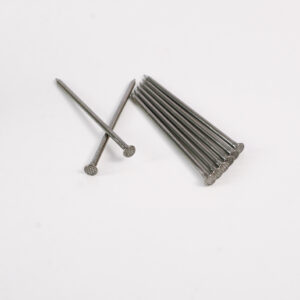
Screw nails – also called threaded nails, spiral nails or thread-rolled nails – look like ordinary nails at a distance but hold like screws when driven. The shank carries a continuous helical thread that rotates the nail into the wood as it is driven, pulling the head tight against the surface and locking the joint against vibration and withdrawal. For pallet plants, crate builders, furniture factories and construction importers, screw nails are one of the most cost-effective upgrades from plain smooth-shank nails.
This guide covers how screw nails are made, the thread types you can order, sizes and gauges, coatings, applications, and the specification fields that get you an accurate quote. If you are comparing shank types first, our ring shank vs smooth shank guide explains the neighbouring fastener family.
What Are Screw Nails?
A screw nail is a nail with a helical (spiral) thread rolled or twisted into the shank. In Chinese fastener production the process is called 搓丝 (thread rolling): the nail shank passes between two hardened thread-rolling dies that press the thread into the steel without cutting it. Rolling, rather than cutting, keeps the steel fibres intact, which is why rolled threads are stronger and cheaper to produce at volume than cut threads.
When a screw nail is driven with a hammer or nail gun, the helix causes the nail to rotate and bore into the wood. The thread performs two jobs at once:
- Withdrawal resistance: the thread mechanically locks into the wood fibres, so the nail resists being pulled out – typically far better than a smooth nail of the same size.
- Reduced splitting: because the nail rotates into the wood instead of wedging straight in, screw nails are much less likely to split hardwoods and dense softwoods.
Screw nails are not screws: they have no head recess, they are driven by impact, and they are not designed to be removed. That trade-off is exactly why they are faster to install than screws while providing screw-like holding power.
Types of Screw Nails
Within the screw nail family, buyers can choose between three shank patterns:
- Single-thread (spiral) screw nails: one continuous helix along the shank. This is the standard general-purpose type for pallets, crates, decking and joinery.
- Double-thread screw nails: a second, faster-pitch thread running alongside the first. Double-thread nails give maximum withdrawal resistance and are preferred for pallet deck-to-stringer joints and heavy crates.
- Spiral shank (twist) nails: a square or rectangular shank twisted along its length rather than rolled with a round thread. They combine a strong grip with good resistance to rotation, and are common in flooring and fencing.
The distinction matters on an order: “threaded nails” can mean ring shank, screw shank or double-threaded, and each behaves differently in service. Always state the thread pattern and whether you need single or double thread.
Screw Nails vs Ring Shank Nails vs Smooth Nails
| Factor | Smooth shank | Ring shank | Screw (threaded) shank |
|---|---|---|---|
| Withdrawal resistance | Baseline | Roughly 1.5-2x smooth | Comparable or higher |
| Resistance to rotation | Low | Good | Best (twist locks into fibres) |
| Wood splitting | More likely | Moderate | Reduced by the thread action |
| Driving speed | Fastest | Fast | Slightly slower (rotates in) |
| Removal / rework | Easy | Difficult | Very difficult |
| Typical price | Lowest | Medium | Medium-high |
In practice, ring shank and screw shank nails overlap in performance, and the best choice depends on the application. Screw nails tend to pull the joint members together as they drive and reduce splitting in hardwood, which is why pallet plants and hardwood furniture factories often choose them.
Screw Nail Sizes and Gauges
Screw nails are specified by length and shank diameter (gauge), like other nails. The sizes below are the most frequently ordered in export trade:
| Length | Inches | Typical gauge | Common applications |
|---|---|---|---|
| 25mm | 1″ | 11-12 | Light crating, furniture frames, interior joinery |
| 40mm | 1-1/2″ | 11 | Light pallets, boxes, fencing battens |
| 50mm | 2″ | 10-11 | Pallet decking, crates, deck boards |
| 63mm | 2-1/2″ | 10 | Heavy crates, formwork, framing |
| 75mm | 3″ | 9-10 | Structural framing, heavy timber |
| 90-100mm | 3-1/2″ – 4″ | 9 | Engineered wood assemblies, heavy construction |
Shank diameters for screw nails commonly range from 2.4mm (12 gauge) to 5.0mm (6 gauge) depending on length and duty. When you see a US order for “screw nails 2 inch” or “screw nails 3 inch”, convert the length to millimetres and confirm the gauge in writing before production – gauge and length together define the nail, not length alone.
Finishes and Coatings
The thread provides the holding power; the coating decides how long the nail survives in its environment:
- Bright (uncoated): the lowest cost option for indoor pallets, crates, furniture and dry framing.
- Electro-galvanized: a thin, bright zinc layer for indoor and semi-exposed work where light corrosion protection is enough.
- Hot-dip galvanized (HDG): a thick zinc coating for exterior decking, fencing, agricultural buildings and coastal areas.
- Phosphate / black oxide: a dark coating that adds a little lubricity and rust resistance, common on collated nails for dry interior use.
- Stainless steel: for marine, food-processing and chemically aggressive environments where any rust is unacceptable.
“Galvanized screw nails” is not a complete specification – electro and hot-dip are very different products in corrosion life. State the coating type and, for exterior work, the zinc coating weight on the RFQ.
Applications for Screw Nails
- Pallets and crates: transport vibration is the main cause of loose nails. Screw nails keep deck boards tight to stringers through repeated handling, stacking and container transit, which is why export-grade pallet programs specify them for load-bearing joints.
- Decking: exterior deck boards fixed with hot-dip galvanized screw nails stay tight through wet-dry cycles and are less likely to work loose under foot traffic.
- Flooring: spiral shank flooring nails are the traditional fastener for hardwood strip flooring; the twist pulls boards down tight and resists the seasonal movement of the timber.
- Framing: screw nails reduce splitting in dense and engineered lumber while providing strong lateral and withdrawal resistance.
- Formwork and shuttering: vibrating concrete tries to lift the panels; threaded nails hold the form together under repeated use.
- Furniture frames: screw nails hold joints that are later hidden by upholstery or mouldings, where a loose joint would be expensive to repair.
Collated Screw Nails for Production Lines
Pallet, crate and framing plants install screw nails at high speed with collated fasteners. Key details to specify:
- Collation type: wire coil, plastic strip or paper strip – matched to the tool magazine.
- Collation angle: typically 15 degrees for coil pallet nailers, and 21 or 30 degrees for strip framing tools.
- Head style: clipped or round head, depending on the tool and the required pull-through resistance.
- Gauge and length: matched to the timber thickness and the load the joint must carry.
Before committing to a container, run one coil through the actual machine on your line. Collation and feed problems are much cheaper to catch on a sample than after production. Our nail gun compatibility guide explains the angle and head combinations in detail.
How to Specify and Buy Screw Nails
A complete screw nail order specification contains these fields: Thread geometry and dimensional checks for driven fasteners are covered in ASTM F1667 and EN 14592; referencing either helps the factory confirm shank diameter and thread pattern before production.
- Shank type – single-thread, double-thread or spiral twist, stated explicitly.
- Length and gauge – e.g. 50mm x 10 gauge, with tolerances.
- Head style – flat, oval, countersunk or protruding, and head diameter.
- Point type – diamond or blunt, depending on the timber.
- Coating – bright, electro, hot-dip or stainless, with coating weight where relevant.
- Format – loose, collated coil or strip, and the packing unit.
Quality checks at the factory should include thread consistency along the shank, hardness and brittleness (bend test), coating adhesion at the thread edges, and collation integrity for machine-fed nails. For the full inspection procedure, our COA and mill test certificate guide and RFQ checklist cover the paperwork side of a B2B order.
Screw Nail FAQs
Are screw nails better than ring shank nails? Both outperform smooth shank. Screw shank pulls members together and reduces splitting in hardwood; ring shank is often preferred for vibration resistance in pallets and subfloors. Test both for your application.
Can screw nails be driven with a hammer? Yes – screw nails are driven by impact. They take slightly more effort than smooth nails because the thread bites into the wood, but they work well hand-driven or machine-driven.
Do screw nails split wood? Less than smooth nails of the same diameter. The thread bores into the fibres rather than wedging them apart, so screw nails are a common choice for hardwoods and engineered lumber.
What is the difference between a screw nail and a screw? A screw nail is installed by impact and has no driver recess; it is not designed to be removed. A screw is rotated by a tool and can be removed. Screw nails install faster but are permanent.
What sizes do screw nails come in? Typical export sizes range from 25mm (1″) to 100mm (4″), with gauges from 12 to 6. The most popular wholesale sizes are 40mm, 50mm, 63mm and 75mm.
Are stainless steel screw nails available? Yes – stainless screw nails are produced for marine and exterior applications at a premium price, usually in 304 or 316 grade.
Where to Source Screw Nails in Bulk
Kin Metal manufactures screw (thread-rolled) nails in single-thread, double-thread and spiral twist patterns, in sizes from 40mm to 150mm and diameters from 2.4mm to 5.0mm, with bright, galvanized, phosphate or stainless finishes and loose or collated packing. Every quotation states the thread type, size, coating and packing. View our screw nail product page or send your specification for a quotation.