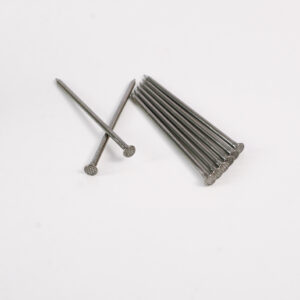
How many nails per kg? The answer depends mainly on the nail’s length and shank diameter. A short, thin common nail weighs much less than a long, thick one, so one kilogram can contain anything from tens of large nails to thousands of small nails.
For example, the reference data below shows approximately 2,380 pieces per kg for 1 × 16 BWG common nails, about 422 pieces per kg for 2 × 12 BWG nails, and about 92.4 pieces per kg for 4 × 8 BWG nails. These figures help importers, wholesalers, building-material distributors, and construction buyers estimate order quantities before confirming packaging and production details.
Important: All quantities in this guide are reference estimates. Actual pieces per kilogram can vary because of head dimensions, shank tolerance, point geometry, steel density, surface coating, and production batch. For a bulk order, confirm the average sample weight and agreed packing tolerance with your supplier.
Common Nails Per Kg Chart
The following common nail weight chart covers 17 sizes. “kg/1,000 pcs” is the estimated weight of 1,000 nails, while “pcs/kg” is the estimated number of nails in one kilogram.
| Size (inch × BWG) | Length (mm) | Diameter (mm) | kg/1,000 pcs | Approx. pcs/kg |
|---|---|---|---|---|
| 3/8 × 20 | 9.52 | 0.89 | 0.046 | 21,730 |
| 1/2 × 19 | 12.70 | 1.07 | 0.088 | 11,360 |
| 5/8 × 18 | 15.87 | 1.25 | 0.152 | 6,580 |
| 3/4 × 17 | 19.05 | 1.47 | 0.25 | 4,000 |
| 1 × 16 | 25.40 | 1.65 | 0.42 | 2,380 |
| 1-1/4 × 15 | 31.75 | 1.83 | 0.65 | 1,540 |
| 1-1/2 × 14 | 38.10 | 2.11 | 1.03 | 971 |
| 1-3/4 × 13 | 44.45 | 2.41 | 1.57 | 637 |
| 2 × 12 | 50.80 | 2.77 | 2.37 | 422 |
| 2-1/2 × 11 | 63.50 | 3.05 | 3.58 | 279 |
| 3 × 10 | 76.20 | 3.40 | 5.35 | 187 |
| 3-1/2 × 9 | 88.90 | 3.76 | 7.65 | 131 |
| 4 × 8 | 101.66 | 4.19 | 10.82 | 92.4 |
| 4-1/2 × 7 | 114.30 | 4.57 | 14.49 | 69.0 |
| 5 × 6 | 127.00 | 5.16 | 20.53 | 48.7 |
| 6 × 5 | 152.40 | 5.59 | 28.93 | 34.5 |
| 7 × 4 | 177.80 | 6.05 | 40.32 | 24.8 |
Decimal figures such as 92.4 pieces per kg describe an average weight relationship. A physical package always contains whole nails and is normally controlled by total net weight rather than by a fractional piece count.
How to Calculate How Many Nails Are in 1 Kg
If you know the average unit weight of one nail in grams, use this formula:
Pieces per kg ≈ 1,000 ÷ average weight per nail in grams
If your specification sheet gives the weight of 1,000 nails, use this formula:
Pieces per kg ≈ 1,000 ÷ kg per 1,000 pieces
Example 1: 2 × 12 BWG Common Nails
The chart gives a weight of 2.37 kg per 1,000 pieces.
1,000 ÷ 2.37 = 421.94
Rounded to the nearest whole nail, this is approximately 422 nails per kg.
Example 2: 3 × 10 BWG Common Nails
The chart gives a weight of 5.35 kg per 1,000 pieces.
1,000 ÷ 5.35 = 186.92
This equals approximately 187 nails per kg.
The calculated result is useful for planning, but a production or packing check should use the actual average weight from the relevant batch.
Why the Number of Common Nails Per Kg Can Vary
Two nails with the same nominal length may not have exactly the same weight. Several details affect the final count.
Nail Length and Shank Diameter
Longer and thicker nails use more steel. As their unit weight increases, the number of nails in one kilogram decreases. Diameter can have a particularly strong effect because a small increase in shank diameter increases the cross-sectional area of the nail.
Head and Point Geometry
Common nails from different drawings may have different head diameters, head thicknesses, or point lengths. These differences change the unit weight even when the nominal length and BWG size are the same.
Manufacturing Tolerances
Wire diameter, cut length, and head formation vary within manufacturing tolerances. Small differences per nail can become noticeable when hundreds or thousands of pieces are packed together.
Surface Finish
Bright, electro-galvanized, and hot-dip galvanized nails may not have identical finished weights. A zinc coating adds material, and coating mass can vary by process and specification. Buyers should therefore avoid using a bright-nail count as a guaranteed count for a galvanized order.
Counting and Weighing Method
Most bulk common nails are sold and packed by net weight. A pieces-per-kilogram figure is usually an average used for estimation, not a promise that every 1 kg package contains exactly the same number of nails.
For more information about finishes, sizes, and applications, see our Common Nails: Sizes, Materials, Uses and Bulk Buying Guide.
How to Estimate Nails Per Bag or Carton
Once you have the reference pieces-per-kilogram figure, multiply it by the package’s net weight:
Estimated pieces per package ≈ pcs/kg × package net weight in kg
For a 25 kg package of 2 × 12 BWG common nails:
422 × 25 = approximately 10,550 nails
This is a planning estimate. The commercial package should still be checked according to net weight, actual nail specification, and the packing tolerance agreed with the supplier.
The same method works for other package weights:
- For a 5 kg bag, multiply the reference pcs/kg by 5.
- For a 10 kg carton, multiply the reference pcs/kg by 10.
- For a 20 kg carton, multiply the reference pcs/kg by 20.
- For a master carton containing smaller inner boxes, calculate the net nail weight rather than including the weight of boxes and labels.
How to Estimate Nails Per Metric Ton
One metric ton equals 1,000 kg. The basic calculation is:
Estimated pieces per metric ton ≈ pcs/kg × 1,000
Using the 2 × 12 BWG reference value:
422 × 1,000 = approximately 422,000 nails per metric ton
This conversion can help a buyer compare a quotation stated in metric tons with downstream sales units stated in bags, cartons, or approximate piece counts. However, purchase contracts should define the product by dimensions, finish, net weight, packing method, and tolerance—not only by an estimated number of pieces.
Bulk Buying Checklist for Common Nails
Before requesting a quotation, give the supplier enough information to identify the correct product and packing method.
- Size system: State the nail length and wire size clearly, including whether the diameter is specified in millimetres, BWG, or another gauge system.
- Nail dimensions: Confirm shank diameter, length, head diameter, and any drawing requirements.
- Surface finish: Specify bright, electro-galvanized, hot-dip galvanized, or another required finish.
- Application: Explain whether the nails are intended for general construction, timber work, crating, packaging, or another use.
- Packing unit: State the required net weight per bag, inner box, carton, or other pack.
- Quantity basis: Clarify whether the order is controlled by net kilograms, metric tons, or an agreed piece count.
- Packing tolerance: Agree how net weight and approximate quantity will be checked.
- Labels and cartons: Provide language, barcode, private-label, shipping-mark, and carton-strength requirements before production.
- Sample confirmation: For strict piece-count planning, weigh a representative sample of the final nail specification and finish.
You can also review KIN METAL’s Common Nails product page when preparing your inquiry.
Frequently Asked Questions
How many common nails are in 1 kg?
It depends on the nail size. Based on the reference chart, 1 × 16 BWG common nails are approximately 2,380 pieces per kg, 2 × 12 BWG nails are approximately 422 pieces per kg, and 4 × 8 BWG nails are approximately 92.4 pieces per kg. Actual counts vary with the finished specification and batch.
Can I calculate nail quantity from kg per 1,000 pieces?
Yes. Divide 1,000 by the kg-per-1,000-pieces value. For example, if 1,000 nails weigh 2.37 kg, then 1,000 ÷ 2.37 gives approximately 422 pieces per kg.
How many nails are in a 25 kg carton?
Multiply the reference pieces per kilogram by 25. For example, 2 × 12 BWG common nails at approximately 422 pieces per kg would give an estimated 10,550 pieces in 25 kg. The actual carton quantity should be confirmed from the production batch and net weight.
Do galvanized nails have the same pieces-per-kg count as bright nails?
Not necessarily. Zinc coating adds weight, and the finished head and shank dimensions may also differ. Use a sample or batch-specific average weight when the required quantity tolerance is strict.
Should I order common nails by weight or by piece count?
Bulk common nails are often ordered and packed by net weight because it is efficient for production and shipping. If downstream sales depend on a specific piece count, define the counting method and tolerance in the purchase agreement.
Request a Common Nail Quote
Need help estimating how many nails per kg, carton, or metric ton for your required specification? Send KIN METAL the nail size, diameter, finish, package weight, total order quantity, and destination market. We can review the requirements and prepare a quotation based on the specification you provide.
Request a common nail quotation
Written by the KIN METAL Editorial Team. Reviewed by Evin, Export Sales Specialist.