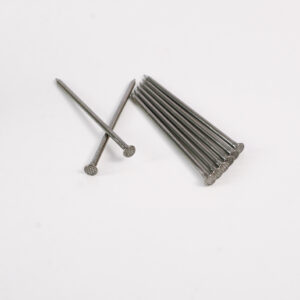
An order line that reads umbrella head roofing nails, BWG9, 2.5 inch, twisted shank describes one fastener through four separate decisions: the head profile, the wire gauge, the length and the shank design. Each one changes the price per tonne and each one changes how the nail behaves on the roof. An importer who reads that line loosely can receive nails at exactly 63.5 mm long with the wrong shank diameter, and the mistake only becomes visible once the sheets start lifting in wind.
This guide takes the specification apart piece by piece, gives the BWG to millimetre conversion you need to check a quotation, and lists what to confirm before a bulk order of this size goes into production.
Decoding the specification
Four words, four meanings. Suppliers in different markets use these terms loosely, so it is worth fixing each one before the order is placed.
| Term | What it controls | Typical value for this line |
|---|---|---|
| Umbrella head | Head diameter and profile. Decides the bearing area on the sheet and whether the nail pulls through | Domed, semicircular profile. Commonly quoted between 9 mm and 12 mm head diameter for a nail of this length |
| BWG9 | Shank (wire) diameter. Decides weight per tonne and withdrawal resistance | 0.148 inch / 3.76 mm nominal |
| 2.5 inch | Overall length under the head. Decides whether the nail reaches the batten | 63.5 mm |
| Twisted shank | Mechanical grip in the timber. Decides resistance to wind uplift and thermal movement | Spiral twist along the shank, smooth point |
The values in the right-hand column are production conventions, not fixed standards. The number that governs your order is the one on the approved drawing or the approved sample, so confirm both before the line is scheduled.
BWG explained, and why the gauge matters more than the length
BWG stands for Birmingham Wire Gauge, also called the Stubs Iron Wire Gauge. It is a descending scale: a higher BWG number means thinner wire. BWG9 is therefore thinner than BWG8 and thicker than BWG10. This is the opposite of how most people read a number, and it is the single most common source of specification errors in nail enquiries.
| BWG | Inch | Millimetre (nominal) | Typical roofing use |
|---|---|---|---|
| 6 | 0.203 | 5.16 | Heavy sheet fixing, long lengths |
| 7 | 0.180 | 4.57 | Heavy duty roofing |
| 8 | 0.165 | 4.19 | Long roofing nails, high wind load |
| 9 | 0.148 | 3.76 | 2.5 inch and 3 inch roofing nails |
| 10 | 0.134 | 3.40 | Standard 3 inch roofing and clout nails |
| 11 | 0.120 | 3.05 | 2 inch roofing, general construction |
| 12 | 0.109 | 2.77 | 2 inch roofing, felt fixing |
| 13 | 0.095 | 2.41 | Felt nails, light sheet |
| 14 | 0.083 | 2.11 | Felt and membrane fixing |
| 15 | 0.072 | 1.83 | Light felt, insulation |
| 16 | 0.065 | 1.65 | Lightest roofing felt work |
BWG is not SWG
This is where disputes start. Some markets, the United Kingdom in particular, still quote wire in SWG (Standard Wire Gauge, also called Imperial Wire Gauge). The two scales are close but not identical, and the gap is large enough to matter commercially.
| Gauge | BWG | SWG | Difference |
|---|---|---|---|
| 8 | 4.19 mm | 4.06 mm | 0.13 mm |
| 9 | 3.76 mm | 3.66 mm | 0.10 mm |
| 10 | 3.40 mm | 3.25 mm | 0.15 mm |
| 11 | 3.05 mm | 2.95 mm | 0.10 mm |
| 12 | 2.77 mm | 2.64 mm | 0.13 mm |
A 0.10 mm difference on a 3.76 mm shank is about 5 percent of the cross-sectional area, which translates into roughly 5 percent of the steel weight and roughly 5 percent of the price per tonne. On a 25 tonne container that is not a rounding error. If your enquiry says only “9 gauge”, ask which gauge scale the factory is quoting against, and put the millimetre diameter in writing as well as the gauge.
Gauge versus millimetre tolerance
Most wire nail production is run to a millimetre target rather than to a gauge, because the drawing dies are set in millimetres. A tolerance of plus or minus 0.05 mm to 0.10 mm on shank diameter is normal in the industry. Ask three questions before you buy:
- Is the nominal 3.76 mm, or the factory working to 3.7 mm or 3.8 mm round?
- What is the accepted tolerance band, and is it written on the order confirmation?
- Where and how is the diameter measured, on the bare wire or on the finished coated nail?
Why 2.5 inch (63.5 mm) is a common roofing length
2.5 inch is the middle of the roofing range. It is long enough to pass through a corrugated sheet profile, any washer or cap and still reach useful depth into a timber batten, and short enough to stay economical on a fixed-price project.
The length only works if the nail reaches far enough into the timber. Timber design codes commonly call for a pointside penetration of roughly 8 to 12 times the shank diameter for structural connections. For a 3.76 mm shank that means somewhere between 30 mm and 45 mm of the nail inside the timber. Check the code that applies to your project rather than assuming, but the arithmetic gives you a starting point:
- Nominal length under head: 63.5 mm
- Less the sheet profile and any washer or cap it passes through
- The remainder must cover the required pointside penetration into the batten or purlin
Run that calculation before you fix the length. A 2.5 inch nail that only achieves 20 mm of penetration is a specification problem, not a manufacturing problem, and it will not be resolved by changing supplier.
Twisted shank: what it does and when to specify it
A twisted shank carries a spiral deformation along its length. Driven into timber, the twist cuts a matching thread in the wood fibres and creates mechanical interlock rather than relying on friction alone. The practical result is higher withdrawal resistance, which is exactly what a roof needs: sheets expand and contract with temperature, and wind uplift applies a repeated pull on every fastener.
For withdrawal resistance, the general order across shank types runs smooth, then twisted or screw shank, then ring shank. Twisted shanks usually drive more smoothly than ring shanks and are less likely to tear the timber, which is why they are common on roofing work. Actual performance depends on timber species, density, moisture content, nail dimensions and driving method, so treat the ranking as a guide and confirm against test data if the load case is critical.
Two limitations are worth knowing before you commit a container to twisted shank:
- Dense hardwood. Twisted shanks can split hard timber without pre-drilling, and they drive more slowly. For softwood battens and purlins, the usual roofing substrate, this is rarely an issue.
- Power tools and collation. If the nails are to be fed through a coil or strip nailer, confirm that the tool accepts a twisted shank and the collation angle. Hand-driven and collated versions of the same nominal nail are different products.
If your project does not need the extra grip, a smooth shank at the same gauge and length is cheaper and faster to install. Our comparison of ring shank and smooth shank nails covers the holding power side in more detail, and the umbrella head roofing nails guide covers how shank choice fits into a roof fixing specification.
Umbrella head: diameter, thickness and why size matters here
The umbrella head is a domed, semicircular head that sits above the shank. Its job is to spread the fixing load across a wider area of the sheet so the nail does not tear through thin material under wind load. It also sits neatly over the corrugation without the flat head edge biting into the profile.
Three head dimensions belong on the order:
- Head diameter. Across the roofing range this is commonly produced from about 8 mm to 14 mm. For a 2.5 inch BWG9 nail, something in the 9 mm to 12 mm band is typical. Bigger heads spread load better but need more steel and take more space in the carton.
- Head thickness. Thicker heads resist deformation when driven, but add weight. This is a cost lever, not just a quality lever.
- Head profile. Dome height and the radius where the head meets the shank. A sharp transition concentrates stress and is where heads shear off under impact.
If the nail is supplied with a plastic or metal washer, cap or sealing ring, the head diameter has to match the washer seat. Ordering a 12 mm head for a washer designed around a 10 mm head defeats the purpose of the washer.
Finish options for a BWG9 2.5 inch twisted shank nail
Roofing is an external application, so the finish is not an afterthought. It decides service life and it is usually the largest single variable in the price per tonne after the gauge.
| Finish | Typical coating mass | Where it is appropriate |
|---|---|---|
| Bright / polished | None | Dry internal work only. Not for roofing |
| Electro-galvanized | Roughly 8 to 25 g/m² | Sheltered or short-exposure applications |
| Hot-dip galvanized | Commonly 45 to 90 g/m² | Exposed roofing, general external work |
| Mechanical galvanized | Can be specified higher and is more uniform | Coastal, industrial and high-humidity sites |
| Sprayed / painted | Depends on system | Colour matching to the sheet, decorative work |
Coating masses quoted by different factories are not always measured the same way, so state the test method as well as the figure. If corrosion performance is critical, ask for the coating mass test result on the actual production lot rather than the nominal value on the data sheet. Our electro-galvanized versus hot-dip galvanized comparison explains how the two processes differ.
One detail specific to this specification: galvanizing adds a film to the surface. At typical roofing coating masses the diameter increase is small, in the order of a few hundredths of a millimetre, but on a gauge-critical order it is still worth stating whether the 3.76 mm applies to the bare wire or the finished nail.
A complete specification line to send your supplier
Quotations go wrong when the enquiry is one line long. This is the level of detail that removes ambiguity on a BWG9 2.5 inch twisted shank order.
| Item | Example value |
|---|---|
| Product | Umbrella head roofing nail, twisted shank |
| Shank diameter | BWG9, nominal 3.76 mm, tolerance to be confirmed |
| Longitud | 2.5 inch / 63.5 mm under head |
| Head | Semicircular umbrella head, diameter and thickness to drawing |
| Point | Diamond point |
| Material | Q195 or Q235 low carbon steel wire |
| Finish | Hot-dip galvanized, coating mass stated |
| Embalaje | 25 kg carton, buyer’s label |
| Quantity | Per size, with total container weight |
| Inspection | Dimensions, head integrity, twist consistency, coating mass |
| Documents | Packing list, mill test certificate, coating test report |
The same discipline applies to comparing what comes back. Our nail quotation RFQ checklist sets out what to line up side by side so that two apparently similar prices are actually comparable.
Estimating quantity: nails per kilogram and per tonne
Buyers frequently need a piece count to compare against a project take-off. You can estimate it from the geometry, and the estimate is close enough for planning.
Working through a BWG9, 2.5 inch umbrella head twisted shank nail with a 10 mm head diameter and a 7 mm point:
- Shank volume at 3.76 mm diameter over 63.5 mm is about 705 mm³
- Add the umbrella head, roughly 85 mm³ at 10 mm diameter
- Subtract the tapered point, roughly 26 mm³
- Net volume is about 765 mm³. At a steel density of 7.85 g/cm³ that is roughly 6 grams per nail
That works out to approximately 160 to 170 nails per kilogram, or roughly 160,000 to 170,000 nails per tonne. Change the head diameter and the figure moves, so treat it as a planning estimate and confirm it by counting a weighed sample before you commit to a project quantity. The general method is set out in our guide to how many nails per kg.
Quality checks specific to this specification
A generic nail inspection misses the points that matter on a gauge-critical roofing order. These are the checks worth writing into the inspection plan:
- Shank diameter. Measured with a micrometer on the bare wire, in two directions at right angles, at several points along the shank. A single reading on a coated nail is not sufficient.
- Length under head. Measured from the underside of the head to the point of the nail, not overall.
- Head diameter and thickness. Compared against the approved drawing or sample, not against a nominal description.
- Twist consistency. The spiral should run evenly along the shank with no flattened or untwisted sections, which indicate worn forming rolls.
- Head to shank junction. Check the fillet for cracking or thinning. This is where failures start.
- Point. Properly formed and concentric with the shank. An off-centre point causes the nail to run offline when driven.
- Straightness. Bent nails jam collation and nailers.
- Coating mass. Weigh, strip and re-weigh per the agreed method, on a sample from the production lot.
If your order includes a sampling plan, set the acceptance criteria against the drawing before production starts. Our nail sampling plan guide covers how to structure the sample sizes.
Packing and container loading
Packing for this size follows the usual export formats: 25 kg cartons, 20 kg cartons, 5 kg and 1 kg boxes for retail channels, and 50 lb bags for North American buyers. Carton dimensions are driven by the head diameter, because a wider umbrella head wastes space between the nails, so a change from a 10 mm to a 12 mm head can reduce the number of nails per carton at the same weight.
Steel nails are dense, and containers normally cube out before they weigh out. A 20 ft container typically carries in the region of 20 to 25 tonnes of packed nails, subject to the carrier’s payload limit and the pallet configuration. Tell your supplier whether the goods ship palletised or floor loaded, because it changes the loadable weight noticeably.
Frequently asked questions
What does BWG9 mean in millimetres?
BWG9 is 0.148 inch, or a nominal 3.76 mm shank diameter. On the Birmingham Wire Gauge scale a higher number means thinner wire, so BWG9 is thicker than BWG10. Check whether your supplier is quoting BWG or SWG, because SWG9 is 3.66 mm, about 0.10 mm thinner.
Is 2.5 inch the same as 63.5 mm?
Yes. 2.5 inch converts to exactly 63.5 mm. Confirm that the length is measured under the head rather than overall, and state which of the two you mean on the order.
Are twisted shank roofing nails better than smooth shank?
For withdrawal resistance, yes. The twist creates mechanical interlock in the timber, which helps resist wind uplift and the repeated movement of sheets as they expand and contract. Smooth shanks drive faster and cost less, so use them where holding power is not the limiting factor.
What umbrella head diameter should I specify?
For a 2.5 inch BWG9 nail, a head diameter between 9 mm and 12 mm is typical in production, although the full roofing range runs from roughly 8 mm to 14 mm. The correct value depends on the sheet profile and on any washer or cap the nail has to seat into, so confirm it against the approved drawing.
Does galvanizing change the shank diameter?
It adds a thin zinc film. At typical roofing coating masses the increase is small, in the order of a few hundredths of a millimetre, but on a gauge-critical order you should state whether the specified diameter applies to the bare wire or the finished coated nail.
Which finish is right for a coastal roof?
Hot-dip galvanized or mechanical galvanized. Coastal air, industrial pollution and high humidity all accelerate corrosion, and a heavy zinc coating lasts considerably longer than a light electro-galvanized layer. State the service environment on the enquiry and ask for coating mass test results per lot.
What is the minimum order quantity?
Nail production normally starts from about 1 tonne per size and finish. Mixed orders combining several sizes are common, and the total can be arranged across a 20 ft or 40 ft container to keep freight efficient.
Request an umbrella head roofing nails quotation
Send KIN METAL your specification line with the gauge and millimetre diameter, the length, the head diameter, the finish and coating mass, the packing format, the quantity per size and the destination port. We produce umbrella head roofing nails in Q195 and Q235 carbon steel with smooth or twisted shanks, in polished, electro-galvanized, hot-dip galvanized and sprayed finishes. Review the roofing nails product page for the available range.
For container pricing and lead times, contact us with your specification and we will confirm production options against your requirements.
Written by the KIN METAL Editorial Team. Reviewed by Evin, Export Sales Specialist.