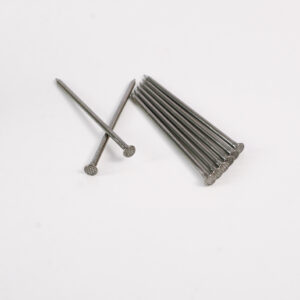
Common round nails are the general-purpose wire nails most construction buyers recognize by sight: a flat round head, a smooth round shank and a diamond point. The name changes with the market. Buyers in the United States ask for common nails, UK and Irish merchants often list them as round wire nails, and importers across Africa, the Middle East and South East Asia order them as round nails. It is the same round-head wire nail family, and the specification behind it is what decides your price per ton.
This guide covers the sizes, head and shank options and surface finishes available for bulk supply, plus the details worth confirming before you place a container order.
What are common round nails?
A common round nail is a low-carbon steel wire nail with a round cross-section shank and a flat, round head. Wire is drawn to the required gauge, cut to length, headed and pointed. Because the shank is round and smooth, the nail drives straight and holds through friction and the compression of the timber around it.
The features to confirm on any order:
- Head: flat round head, normally about twice the shank diameter, seated flat against the timber surface.
- Shank: round and smooth as standard. Ring shank and screw shank versions are available where withdrawal resistance matters more than driving speed.
- Point: diamond point, ground to a sharp tip so the nail starts without crushing the timber fibres.
- Material: Q195 or Q235 low-carbon steel wire in standard production, with stainless steel available for exposed work.
- Length range: from 3/8 inch up to 7 inch in regular production, quoted in inches or millimetres.
One detail causes most of the confusion in quotations. “Common” describes the head and shank weight of the nail, not one fixed product. Two suppliers can both quote 2 inch common round nails and deliver different wire diameters, different head sizes and different carton weights. Always confirm the gauge in writing. Our British vs American nail terminology guide explains how the same fastener is named in different markets.
Common round nails and other nail types compared
Buyers often compare round nails with the other fasteners on the same shelf. The differences sit in the head shape and the shank, and they decide which jobs each nail suits.
| Nail type | Head | Shank | Holding power | Typical use |
|---|---|---|---|---|
| Common round nail | Flat round head | Round, smooth | Good | General construction, crates, pallets, framing |
| Clout nail | Flat, wide head | Round, short | Moderate | Roofing felt, battens, thin sheet materials |
| Umbrella head roofing nail | Raised umbrella head | Round, smooth or twisted | Good to high | Corrugated roofing sheets on timber supports |
| Box nail | Small flat head | Round, thinner | Lower | Light framing, crates, trim work |
| Ring shank nail | Flat round head | Annular rings | High | Pallets, fencing, soft timber, wind load areas |
| Screw (twisted) nail | Flat round head | Continuous spiral | High | Hardwood, flooring, applications needing grip |
Common round nail sizes and diameters
Export orders are quoted by length in inches or millimetres, with the wire gauge (BWG) confirming the diameter. The figures below are the sizes that move in the largest volumes, together with reference weights.
| Size (inch × BWG) | Length (mm) | Diameter (mm) | kg / 1,000 pcs | Common use |
|---|---|---|---|---|
| 1 × 16 | 25.40 | 1.65 | 0.42 | Light crates, thin timber, general fixing |
| 1-1/2 × 14 | 38.10 | 2.11 | 1.03 | Boxes, light framing, furniture |
| 2 × 12 | 50.80 | 2.77 | 2.37 | Pallets, crates, general construction |
| 2-1/2 × 11 | 63.50 | 3.05 | 3.58 | Batten work, fencing, general framing |
| 3 × 10 | 76.20 | 3.40 | 5.35 | Framing, fencing, formwork |
| 4 × 8 | 101.66 | 4.19 | 10.82 | Heavy framing and timber structures |
| 5 × 6 | 127.00 | 5.16 | 20.53 | Heavy timber, sleepers |
| 6 × 5 | 152.40 | 5.59 | 28.93 | Heavy structural timber |
The two sizes that move in the largest volume are 2 inch round nails (50 mm, 12 BWG) and 3 inch round nails (75 mm, 10 BWG). Both suit pallets, crates, fencing and general framing, which is why distributors in most markets keep them in stock in bright and galvanized finishes.
Weight and piece count are linked. If your customers buy by weight but sell by piece, you need the conversion before you fix a retail price. Our nails per kg chart lists 17 sizes with the formulas for converting between kilograms, cartons and metric tons.
Head and shank options
Standard production covers a smooth shank with a flat round head. Where the application demands more grip, two alternatives are common.
Ring shank. Annular rings are rolled into the shank so the timber closes around them. Withdrawal resistance rises sharply compared with a smooth shank, which is why ring shank nails are specified for pallets, fence rails, plywood and any joint exposed to movement.
Screw shank. A continuous spiral gives the nail a twisting action as it drives. Screw shank nails hold well in hardwood and in flooring, and they resist being pulled out by repeated loading.
Head sizes can also be adjusted. A slightly smaller head drives flush more easily and is sometimes requested for finishing work, while the standard full round head gives the largest bearing surface and the best performance in soft timber.
Surface finishes for common round nails
Finish drives both the price and the service life. Three options cover most orders.
| Finish | Corrosion resistance | Surface | Best for |
|---|---|---|---|
| Bright (polished) | None | Smooth, shiny | Indoor work, dry timber, crates, pallets for export packing |
| Electro galvanized | Moderate | Smooth, even coating | Indoor and sheltered outdoor work, general construction |
| Hot-dip galvanized | High | Thicker, slightly rougher coating | Outdoor, humid, coastal and treated timber applications |
Zinc coating is measured in grams per square metre, and the figure should be written into the order rather than left to interpretation. Hot-dip galvanized nails carry a heavier coating than electro galvanized, which is why they cost more and last longer in wet conditions. If your project or customer specification names a coating weight, confirm the achievable range before production starts. Our guide to specifying galvanized nails sets out the wording to use in a purchase order.
Steel grades and material choice
Carbon steel round nails are produced from Q195 or Q235 wire in normal supply. Q195 is softer and bends more readily, which suits general fixing. Q235 gives more strength and is chosen for heavier sections and structural work.
Where corrosion resistance must last for years, stainless steel round nails in grade 201, 304 or 316 replace the carbon steel versions. 304 covers most outdoor and freshwater exposure, while 316 handles chlorides and saltwater. Stainless nails cost several times more than galvanized, so they are usually restricted to marine, coastal and food industry applications.
Where common round nails are used
Round nails sit in the middle of most supply catalogues because the same product serves many trades:
- General construction: framing, studwork, sheathing and fixing battens to timber.
- Pallets and export crates: assembled with 2 inch to 3 inch nails, often bright or electro galvanized.
- Fencing and agriculture: fence rails, posts, wire support and farm repairs, usually hot-dip galvanized.
- Roofing support: battens and counter battens beneath the covering.
- Furniture and joinery: frames, crates and internal structures where a round head is acceptable.
- Formwork and site work: temporary structures where a heavier gauge drives reliably.
Each application shifts the size and finish. A pallet manufacturer may buy bright 2 inch nails by the ton, while a roofing supplier in a coastal region will order 3 inch hot-dip galvanized.
How to specify common round nails in an RFQ
A clear enquiry removes most of the back-and-forth that delays a quotation. Include these fields:
- Length, with the unit stated (inch or mm).
- Wire diameter or BWG gauge. If you only have a sample, say so and send the measurement.
- Head type and shank type.
- Surface finish, and the coating weight if it is specified.
- Order quantity per size, not only the total.
- Packing format: bulk carton, bag, small box or retail pack, with the weight per unit.
- Destination port and any labelling or marking requirements.
- Standard, inspection or certification requirements, plus whether a sample must be approved first.
Nail orders are straightforward when the specification is complete. Our nail specification sheet template gives you a one-page format that covers all of the above and can be attached to the enquiry.
Quality checks before shipment
Small dimensional differences change the weight of a container, so inspection focuses on measurement rather than appearance alone. Points worth checking on common round nails:
- Wire diameter within the agreed tolerance across the sample.
- Length and head diameter to specification.
- Head concentric with the shank, with no offset that would cause the nail to drive crooked.
- Straightness of the shank and a sharp, well-formed point.
- Coating weight and adhesion on galvanized lots.
- Surface condition: no heavy rust, scale or mechanical damage.
- Carton weight and marking matching the order.
Record findings against the lot and keep them with the order file, so any claim can be traced to the shipment it came from. Our common nails inspection checklist lists the checks in a form you can copy into your own purchasing procedure.
Packing and order quantities
Common round nails are normally supplied in 5 kg, 10 kg or 25 kg cartons, with plastic bags, small boxes and retail-ready packs available for distributors who sell in smaller units. Coil weights, carton dimensions, labels, pallet pattern and container loading can all be adjusted to the market.
Minimum order quantities typically start from 1 ton per size, so a mixed order covering several sizes is usual. Carton weight matters more than it appears: lighter cartons cost more in packing material per ton, while heavier cartons reduce handling costs but need stronger board. Tell your supplier which channel the goods are sold through and the packing can be matched to it.
Frequently asked questions
Are common round nails the same as common nails?
Yes. The two names describe the same round-head wire nail. American English uses common nails, while UK and export markets often say round nails or round wire nails. When you order, the length and wire gauge define the product.
What sizes do common round nails come in?
Regular production runs from 3/8 inch to 7 inch. For wholesale orders the most requested sizes are 2 inch (50 mm, 12 BWG) and 3 inch (75 mm, 10 BWG), followed by 1-1/2 inch, 2-1/2 inch and 4 inch.
What is the difference between round nails and clout nails?
Both have round shanks, but clout nails are shorter and carry a wide, flat head designed for roofing felt and battens. Round nails are longer, use a standard round head and are used for general construction and packing.
Which finish should I choose for outdoor use?
Hot-dip galvanized is the usual choice for outdoor, coastal and humid conditions because the coating is heavier than electro galvanized. Bright nails are not recommended for any application exposed to moisture.
What is the minimum order quantity?
Production normally starts from 1 ton per size. A mixed order with several sizes and finishes is common, and the total quantity can be arranged across one 20 ft or 40 ft container.
Can common round nails be supplied in custom packing?
Yes. Bulk cartons, poly bags, small retail boxes and private-label packaging are all available, together with custom carton dimensions, printed labels and pallet configuration for your market.
Request a common round nails quotation
Send KIN METAL your size list with wire gauges, required finish, packing format, order quantity per size and destination port. We produce common round nails in Q195 and Q235 carbon steel with bright, electro galvanized and hot-dip galvanized finishes, and supply stainless steel grades where the application needs them. Review the common nails product page for the available range, or read our common nails buying guide for background on sizes and materials.
For container pricing and lead times, contact us with your specification and we will confirm production options against your requirements.
Written by the KIN METAL Editorial Team. Reviewed by Evin, Export Sales Specialist.